How Trycolors mixes paints for minis and models
Tamiya acrylics as the example
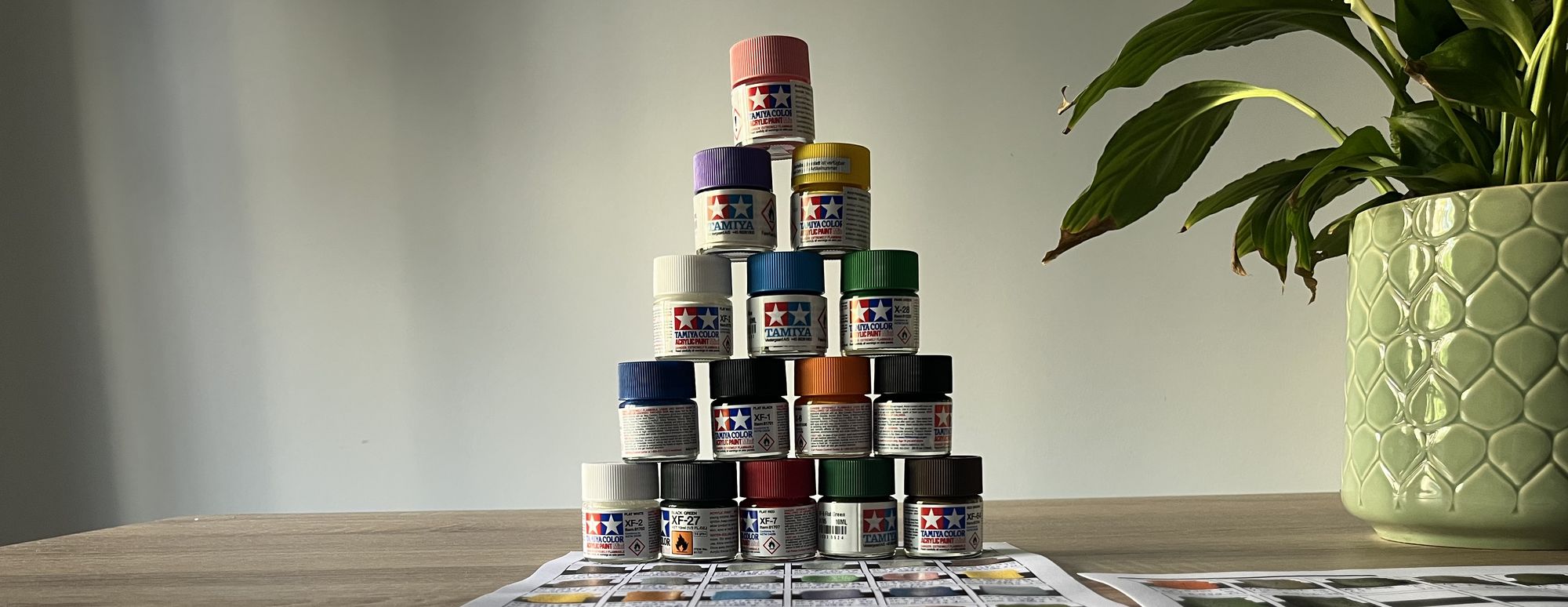
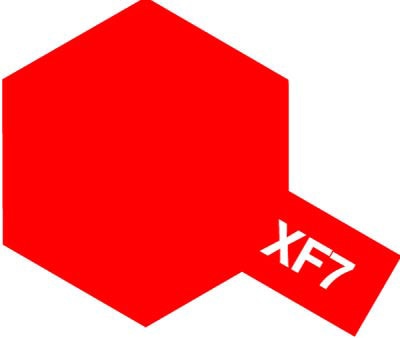
Look up Flat Red XF-7 on Tamiya's website and you see a bright, pure red. Open the jar and the paint is a much deeper red. Charts and apps that copy the website start from that wrong color, which is why so many Tamiya recipes come out wrong. We measured the real paint instead.
In 2026 we started measuring hobby paints on our bench, not only artist paints, and this page shows how, with Tamiya acrylics as the example. We bought the jars, counted and weighed every drop, made test cards and measured each one with a spectrophotometer. The physics behind the engine is in How Trycolors works.
The color on the website is not the paint in the jar
Tamiya shows a small color chip for every paint on its website, and those chips are what gets copied into online charts and apps. We put the chips next to the jars we measured. They are close enough to tell you the name, and too far off to mix from: across the jars we measured the chip and the real paint were a median of about 10 ΔE apart, where 2 is already a difference you can see side by side.
Mixing makes it worse. A recipe built from the website colors starts from the wrong yellow and the wrong red, and every step after that inherits the error.
What is inside the jar matters
Two jars that look alike can be made from different pigments, and then they mix differently. Even a gloss and a flat paint with the same name are not always the same color with a different finish. So before we model a color, we work out what it is made of.
On the bench
Knowing what goes into a jar is not enough. It does not tell you how strong each color is, and strength is what decides a mix. Only paint on a card can answer that.
1The kit
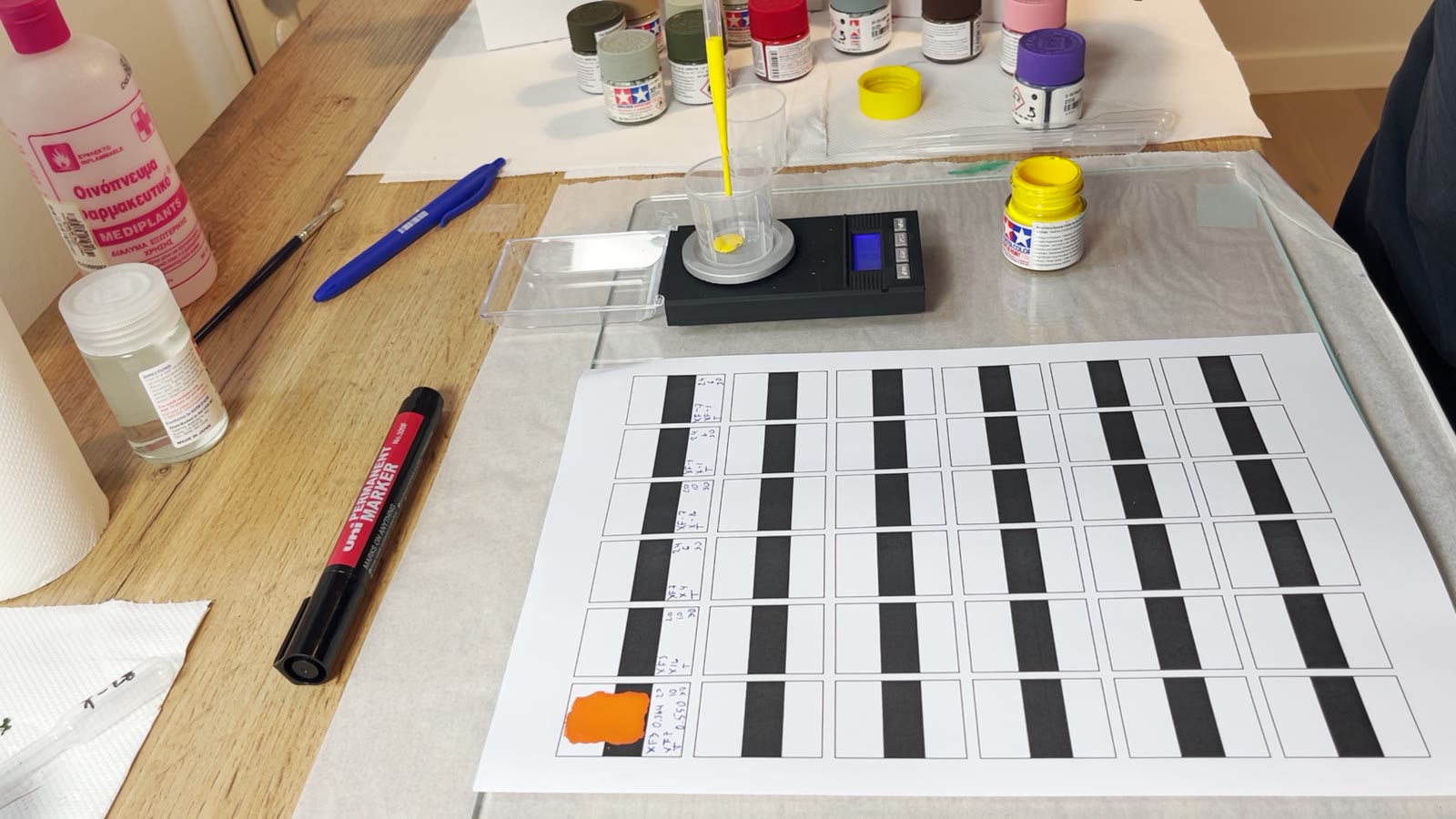
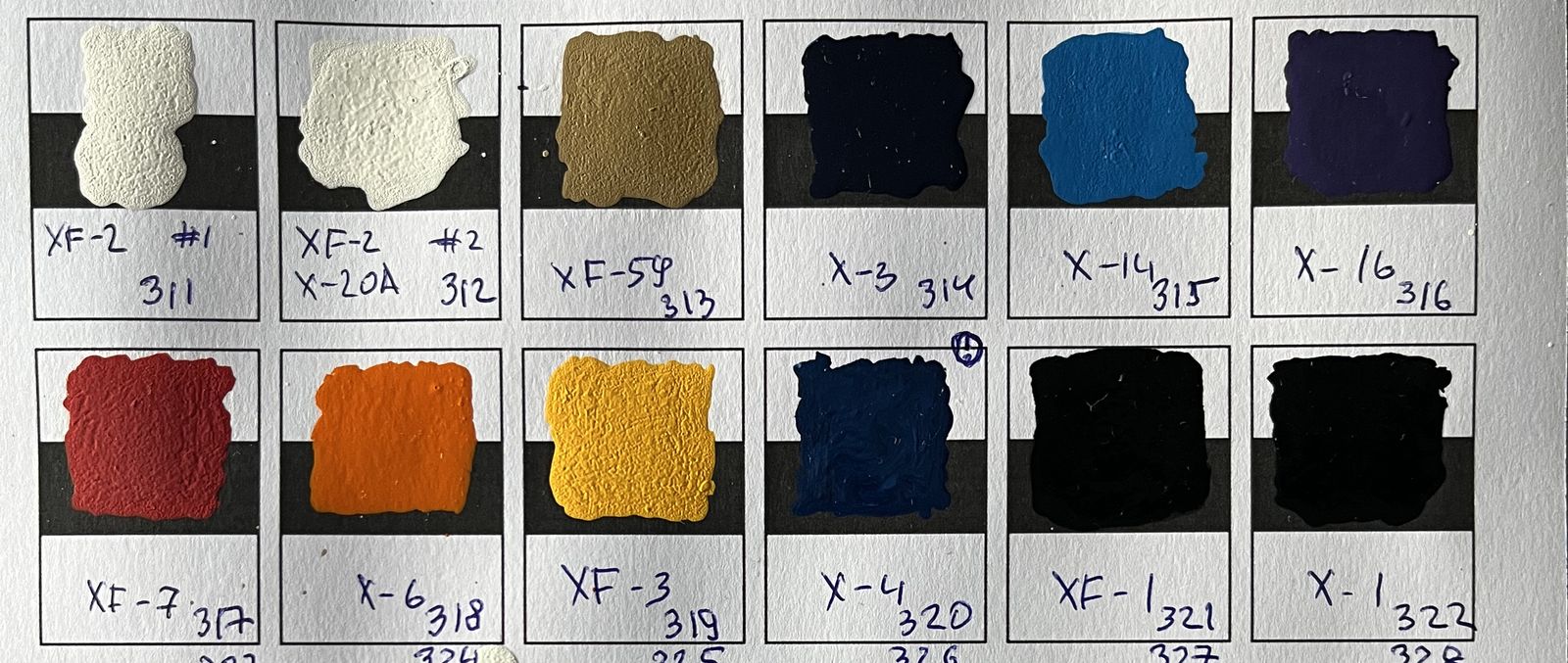
A precision scale weighs every mix, pipettes count the paint out drop by drop, and each card has a white half and a black half. Gloss jars like Blue X-4 get stirred to the bottom and a little X-20A thinner so they level out.
2Count the drops, weigh the mix
Every mix is about 30 drops, for example 20 drops of yellow and 10 of red, and both the drop count and the weight go on the card. Weighing all of them taught us something useful for anyone who mixes Tamiya: a drop is a real measure. A drop weighed 0.0187 g on average, and drops varied by only about 4%, for white, flat and gloss paints alike. Two mixes made by counting drops alone came out practically identical. So a Tamiya recipe written in drops is as good as one written in grams.
3Puddle it onto the card
The mix goes onto the card as a puddle that covers both the white and the black half. A puddle levels itself, so it dries into an even, flat film with no brush marks. Once it is dry we read it over each half. If the two reads agree, the paint hides completely and we are measuring the paint, not the card. On our first session every card agreed within 0.4 ΔE, far below what the eye can see.
That fully hiding film is exactly what the Kubelka-Munk model behind our engine needs: once a film hides the card, its color no longer depends on what is under it or on how thick it is, so one reading describes the paint itself. A brush leaves strokes and an uneven layer, and an airbrush lays down thin coats that need many passes to hide, so both would put the way the paint was applied into the measurement.
We also tried professional drawdown charts, the Leneta opacity cards labs use. The readings were no better than on our own printed cards, so we use compact printed cards: many swatches on one sheet, each with its white and black half.
4Measure it
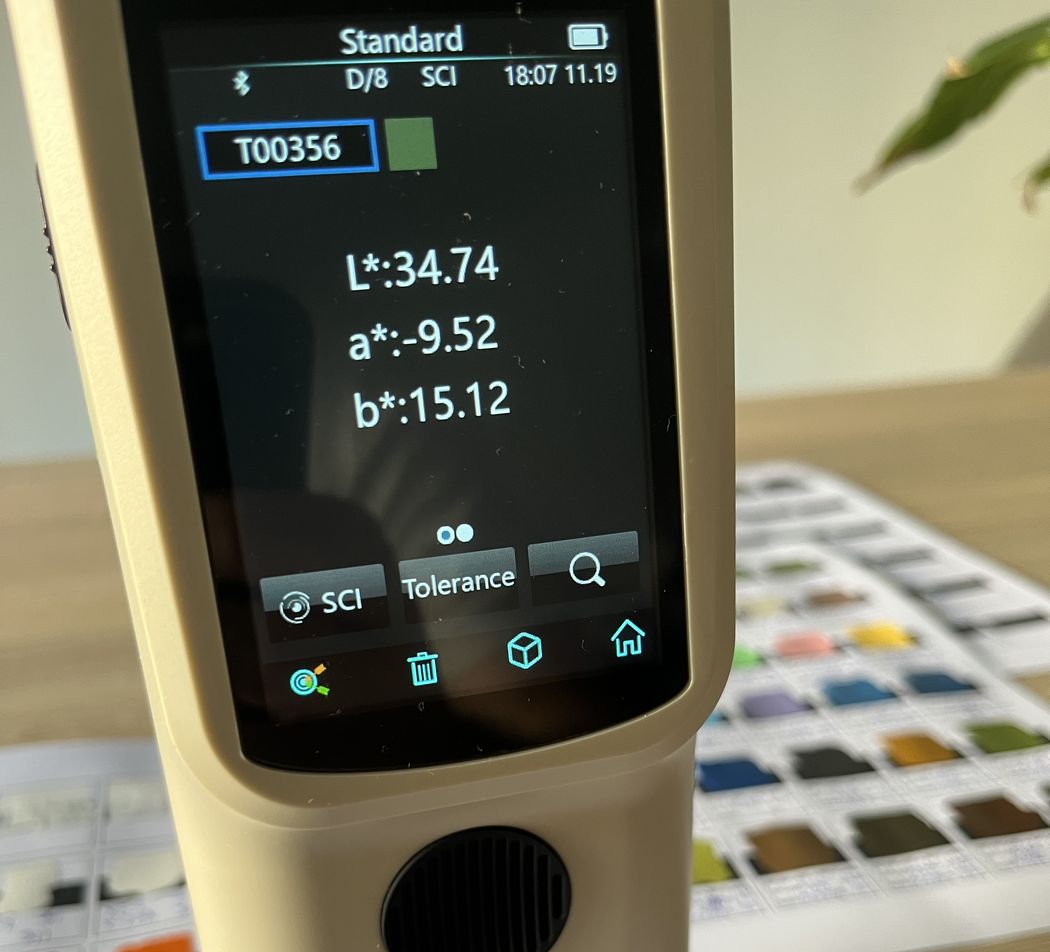
A spectrophotometer sits flat on the dry paint and records how much light it reflects at every wavelength from 400 to 700 nanometers, under standard daylight. That curve, not a photo, is the color.
5Every jar, then tints and two-color mixes
First each jar on its own, then jars mixed with white, then pairs of colors. A painter mixes two jars far more often than three, so those are the mixes we test.
From jars to a mixing model
We do not paint every possible mix. The Tamiya range alone makes thousands of pairs at every ratio, and a model does not need them all on cards. Our engine already holds measured mixing data for a large library of pigments, taken from paints of many brands, artist paints included (how that data is made is in How Trycolors works). A Tamiya jar is made of the same kinds of pigments, so the bench only has to pin down what is particular to each jar: how strong it is and which way it leans. Our method picks the fewest mixes that do that, and the model fills in the rest. The typical difference on mixes we never painted is small enough that the eye barely notices it, about the size of the error you make when you mix by hand.
Colors we have not put on the bench yet are predicted too. To check how well, we hid each measured jar from the model in turn and predicted it as if we had never seen it: the jar landed a median of 2.3 ΔE from the real one, and its mixes 2.9.
Checked on mixes it never saw
A model that only repeats its own data proves nothing, so we test it on mixes it has not seen. For every two-color mix on our cards, we took that pair of paints out of the data, predicted the mix, and compared it with the measured card using ΔE, the standard distance between two colors. Around 1 is the smallest difference a trained eye can catch, and under 2 is hard to tell apart side by side.
Across all of our mixes the median is 1.8 ΔE. Half of them land under 2, and nearly 9 in 10 under 5. Where it misses, the cause is usually strength: a jar that is stronger or weaker than expected. We keep painting mixes for those jars, and every new card makes the model better.
Metallic colors are not in the mixer at all. Metal flake changes with the light in a way this model does not describe, so it never puts a metallic into a recipe.
Try it with Tamiya jars
Here are five of the jars we measured, mixing from the same data. Add a few drops of each and see where the color goes.
Mix from the jars on your shelf
Pick the Tamiya paints you own in the Mixer, or ask for a color and get a recipe from them.
Open the Mixer